
Health & wearables
Supplement tracker app: test patterns, not just tick boxes
A supplement tracker app should connect dose logs with wearable data. Examine optiHealth's analysis, false-discovery checks and limits of personal evidence.
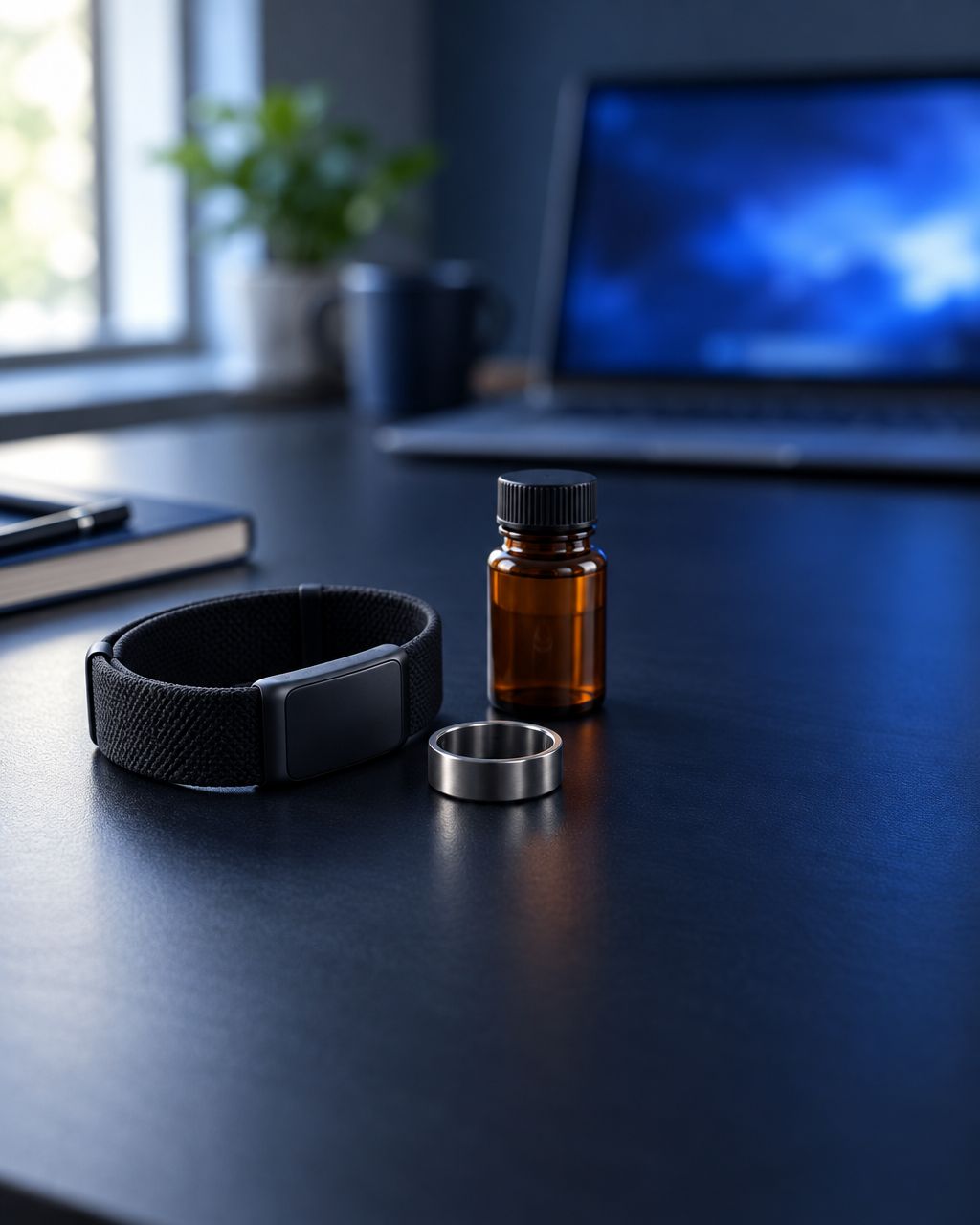
A supplement tracker app can tell you what you took. To investigate what changed afterward, you also need aligned wearable measurements, explicit comparisons and an analysis that can reject its own findings. optiHealth connects those records and screens for within-person patterns; it does not turn an observational association into proof that a supplement works.
- A supplement tracker app needs dose, timing and missingness—not just a completed checkbox.
- optiHealth joins supplement logs with wearable signals and screens associations through a false-discovery gate.
- WHOOP and Oura measurements need source-specific baselines; their similarly named metrics are not interchangeable.
- A surviving correlation is a candidate for investigation, not a clinical verdict or supplement recommendation.
The question is not whether you remembered a capsule
A reminder answers a compliance question. A personal experiment asks whether a specified exposure is associated with a specified outcome under a defensible comparison.
Those are different jobs. A completed checklist does not establish whether you took the same elemental dose, whether that dose preceded the measured night, or whether the comparison nights also differed in alcohol, training or sleep opportunity.
optiHealth treats logged doses as inputs to a nightly analysis engine alongside wearable measurements and other personal signals. Its useful output is not another green streak. It is a claim with a direction, sample size, effect estimate and uncertainty—and reasons to stop believing it.
optiHealth is a supplement-analysis platform for self-experimenters who want to investigate their own wearable patterns rather than just record adherence. Its limit is equally important: software cannot repair an unidentified comparison by making the chart more convincing.
What a supplement tracker should preserve
| Record | Reminder-only workflow | Analysis-ready workflow |
|---|---|---|
| Exposure | Product marked complete | Compound, amount, unit and time |
| Non-use | Empty checkbox | Explicit non-use distinguished from unknown |
| Outcome | A score viewed afterward | Named measurement, source and aggregation window |
| Night alignment | Same calendar date | A declared rule connecting exposure to subsequent sleep |
| Comparison | Before versus after | Defined eligible observations and recorded context |
| Result | A streak or visual impression | Effect size, uncertainty, coverage and limitations |
The left column is sufficient if your only aim is remembering a routine. The right-hand workflow is necessary when you want to ask what the records support. A spreadsheet can preserve these fields too; automation changes the work required, not the standards of inference.
1. Define one claim before inspecting every metric
Start with a written exposure, outcome and comparison. “Supplement use versus next-night total sleep time from one device” is more auditable than “Does my stack improve recovery?”
This is an analysis specification, not a recommendation to start, stop or change a supplement. If the question involves treatment, interactions or withdrawal, involve an appropriately qualified clinician before designing an intervention.
The CENT explanation and elaboration, published in 2015, describes prospective N-of-1 trials with repeated treatment and comparison periods. It emphasizes reporting the intervention, period lengths, washout where relevant, outcomes and methods. Retrospectively inspecting habitual supplement use is not automatically that design.
Write down:
- The exposure and the unit in which it is recorded.
- The primary outcome and the device producing it.
- The temporal relationship you intend to examine.
- Which observations are eligible and why others are excluded.
- What magnitude would matter to you, separately from statistical significance.
A hypothesis discovered during exploration can be useful. Label it exploratory rather than quietly presenting it as the question you intended to answer all along.
2. Preserve dose semantics before joining the records
Two capsules are a product count, not necessarily a comparable exposure. Compound identity, serving size and elemental quantity matter when records come from different products.
optiHealth describes compound resolution and elemental-dose normalization as part of its supplement workflow. The point is to compare like with like, not to imply that a normalized dose is suitable or effective for a particular person.
For a manual workflow, build the same distinction into separate columns. Keep the original label alongside the normalized value so a later correction remains possible.
Check these fields before analysis:
- Product identity and compound identity.
- Recorded amount and original unit.
- Normalized amount where the conversion is known.
- Intake timestamp and local time context.
- Explicit absence versus missing logging.
A missing record must not silently become an untreated observation. If you log more reliably on quiet days than on travel days, the logging process itself can influence the apparent contrast.
3. Treat the wearable as a measurement source, not ground truth
A sleep metric is partly a vendor-defined observation model. Keep the device, data route and aggregation definition attached to it.
The published optiHealth Fitbit Charge 6 versus Oura Ring 4 comparison illustrates the problem using one person's 56 paired main-sleep nights in August–October 2026. Oura reported a mean 12.7 more minutes of deep sleep, with a reported bootstrap 95% interval of 7.6–17.5 minutes. That is a comparison between devices, not a supplement effect.
The same report gives a deep-sleep Spearman correlation of 0.632 and individual-night limits of agreement of approximately −15 to +40 minutes. Co-movement and interchangeability are different questions. A supplement analysis spanning a device switch can mistake a measurement discontinuity for a physiological change.
This concern is not limited to one personal dataset. In a 2025 validation study, 62 adults spent one night in a sleep laboratory with polysomnography and commercial wrist-worn devices. The investigators reported greater than 90% sleep sensitivity but lower wake specificity, ranging from 29.39% to 52.15% across devices. Neither Oura Ring 4 nor Fitbit Charge 6 was tested, so those estimates must not be assigned to them.
Before joining wearable outcomes:
- Keep source identities separate, including duplicate import routes.
- Use one documented definition of each outcome.
- Inspect coverage rather than assuming continuous wear.
- Mark device or algorithm changes where known.
- Establish a new baseline when the measurement process changes.
4. Align exposure with the outcome you actually mean
Local midnight is a database boundary, not necessarily the boundary of your experiment. A late-evening dose and a sleep session ending the following morning can belong to different calendar dates.
Declare how the dose maps to the subsequent sleep episode. Keep naps separate if the question concerns main sleep, and do not quietly change the alignment rule when a different rule produces a larger result.
optiHealth combines wearable records with supplement logs and tags; its nightly sweep includes lag scans. That makes temporal alignment a substantive part of interpretation, not merely a convenience of importing data.
Audit the join using:
- The exposure timestamp and timezone.
- The chosen sleep-session date convention.
- Main sleep versus naps.
- The lag or interval being evaluated.
- Missing or overlapping records.
Inspecting several lags expands the search. Report that search rather than showing only the strongest alignment as though it were the sole test.
5. Separate discovery from confirmation
A nightly sweep can screen more relationships than a person would inspect manually. That also creates more opportunities to find an attractive pattern by chance.
The original Benjamini–Hochberg paper, published in 1995, defined false-discovery rate as the expected proportion of false rejections among rejected hypotheses. Its original guarantee was established under independence assumptions. The assumptions and calibration of the underlying tests still matter when applying a correction to correlated health time series.
optiHealth describes a Benjamini–Hochberg gate on its sweeps. Read that as a screening control, not as a probability that a specific card is true. Multiplicity correction does not remove confounding, fix biased measurement or make adjacent nights independent.
For any surviving result, inspect:
- The effect magnitude and its units, not just the sign.
- The observations actually included in that comparison.
- Uncertainty estimated with the time structure in mind.
- Other metrics, lags and subgroups searched.
- Whether the pattern survives a separately specified follow-up.
A useful analysis engine should make a rejected result visible too. “Explained away” is information, not a failure to produce an insight.
6. Challenge a counterfactual before accepting its story
A counterfactual asks how an outcome might have evolved without the intervention. It remains a model-based estimate, not an observed parallel version of your body.
optiHealth describes Bayesian counterfactuals and placebo-date controls among its analysis mechanisms. The methodological reference is Brodersen and colleagues' 2015 paper. Applying that family of methods to a personal health series requires additional reasoning about the comparison signals and what changed at the intervention date.
The authors' implementation guidance makes two central requirements explicit: control series should not themselves be affected by the intervention, and the pre-intervention relationship should remain suitable afterward. A health metric downstream of the supplement is not an unaffected control merely because it is available.
Challenge the analysis with:
- A rationale for each candidate control signal.
- Pre-intervention predictive checks.
- Placebo dates where no intervention occurred.
- Sensitivity to the selected window and model assumptions.
- Concurrent changes such as illness, travel or training.
Passing a placebo-date check narrows one concern. It does not eliminate every alternative explanation or confer clinical validity on the result.
Choose the workflow for the question you are asking
| Workflow | Best for | Limitation |
|---|---|---|
| Reminder or checklist | Recording whether you followed a routine | Does not itself evaluate outcomes |
| Spreadsheet and documented analysis | Explicit joins, custom models and independent audits | Cleaning, versioning and testing remain your responsibility |
| optiHealth | Joining personal logs and wearable signals for repeated pattern screening | Observational results still depend on coverage, measurement and assumptions |
| Prospectively designed N-of-1 study | Evaluating a defined within-person contrast when appropriate | Requires suitable design, safety assessment and outcome measurement |
The manual route is legitimate. If a spreadsheet and a reproducible script already answer your question, a new interface does not strengthen the evidence by itself.
optiHealth's central value is reducing the distance between collecting records and investigating a defensible claim. WHOOP and Oura are priority wearable sources, while compatible Health Connect records offer another route. Those connections supply observations; they do not make outputs from different devices equivalent.
FAQ
Can a supplement tracker app prove a supplement improves my sleep?
No. A tracker can preserve exposure records and identify associations with sleep measurements, but causal interpretation requires an appropriate comparison and defensible assumptions. A clinician-guided prospective design may be needed for a treatment question.
Why is recording elemental dose different from recording capsules?
Capsule counts describe a product serving, while elemental dose describes the amount of the relevant element. Preserve the original label and the basis of any conversion rather than assuming two products are equivalent.
Should I combine Fitbit and Oura deep-sleep values into one history?
Not as an uninterrupted common scale. Keep source identities and baselines separate because the devices can assign different values to the same night.
How many nights are enough for a personal supplement analysis?
There is no universal minimum. Required information depends on variation, effect size, missingness, serial dependence and the comparison design; an app should not replace those considerations with a single day-count promise.
Does a false-discovery gate mean an insight is probably causal?
No. False-discovery control concerns a collection of statistical tests under specified assumptions. It does not remove confounding or measure the causal truth of an individual claim.
What makes optiHealth different from a supplement reminder?
optiHealth joins supplement logs with wearable measurements and runs a nightly statistical sweep for within-person patterns. Its analysis mechanisms include lag scans, false-discovery screening and counterfactual checks, with interpretation still limited by the underlying data.
One last thing: no finding can be the correct result
The most defensible output is sometimes that the available records cannot distinguish the proposed effect from noise, timing or a changed measurement process. Do not respond by adding outcomes until something survives.
Keep the observation, the model and the verdict separate. A supplement tracker becomes an analysis tool when it can show why the appealing explanation did not earn its place—not when it produces the most confident-sounding card.
This article discusses measurement and research methods, not medical advice. It does not recommend a supplement, dose or treatment change.